
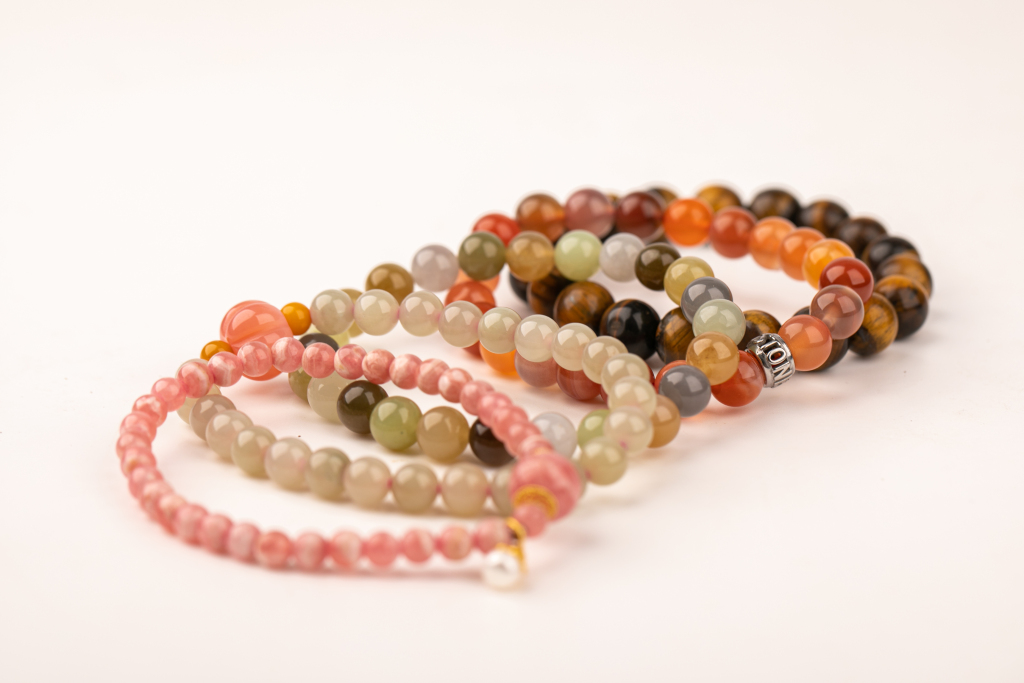
Crystal Energy: Exploring from Ancient Wisdom to Modern Crystal Overview
Therapists and shamans around the world have used crystals for thousands of years. Their use can be traced back to ancient Chinese medical texts from 5,000 years ago, Ayurvedic writings from India, and even the Bible, which contains over 200 references to crystals discussing their energetic properties and symbolic meanings.
Crystal artifacts have been found in prehistoric burial sites across different cultures worldwide, from the Olmec civilization in Central America to ancient Egypt during the pharaohs’ reign. The work “On Stones” (Peri Lithon) written by Greek philosopher Theophrastus (372-287 BCE) laid the foundation for modern scientific classification of minerals. He categorized known minerals based on their origin, physical properties, energetic qualities, and healing characteristics. While modern science still values the information about mineral origins and physical properties, for some reason it has overlooked the descriptions of crystal energy and healing properties.
Today, people everywhere are rediscovering crystals and their healing properties. Many feel that crystals “work naturally” or “feel intuitively right” for them. The healing power of crystals seems to know no bounds.
What are Crystals?
Crystals are natural mineral formations that develop within the Earth’s surface. Although they come in various shapes, colors, and sizes, each crystal is composed of highly ordered atomic structures.
Despite their wide variety, crystals can be distinguished by their color, mineral composition, crystal habits, and hardness. The universally accepted scale for measuring crystal hardness is the Mohs scale, developed by German scientist Friedrich Mohs, which ranks minerals based on their relative hardness.
How do Crystals Work?
There are many explanations for crystal healing effects—mystical, magical, scientific, and pseudoscientific. Until recently, Westerners (myself included) tried to provide physical explanations for crystal healing, but now we understand that crystals work through the body’s energy system, referring to chakras and auras rather than the physical body itself. They influence healing states by affecting this energy system. Throughout history, there are numerous documented accounts of crystal usage, with their scientific and healing capabilities presented as observational evidence.
Scientific Evidence
Without crystals, we wouldn’t have rockets, navigation systems, lunar modules, or Mars rovers… so crystal healing truly represents cutting-edge science! But let’s keep this explanation simple for now.
Today, while science cannot yet prove direct effects of crystals on specific diseases or conditions, it has confirmed that crystals produce energy vibrations and exhibit piezoelectric and pyroelectric effects. It’s also established that crystals can retain heat and electricity, and concentrate subtle energies. Due to these special properties, crystals find practical applications in numerous products—from quartz watches to laser technology—and are used for data storage, such as in the latest 5D (five-dimensional) quartz crystal data storage devices.
Is there any other evidence? Well, we know crystals can enhance the placebo effect (where something produces therapeutic results by altering brain chemistry that makes people “feel better,” rather than having inherent medicinal properties). This occurs commonly in many treatments, even with prescription medications. Finally, if we define magic as “something beyond our current understanding,” explaining crystal effects through magic also makes some sense.
Scientific research on crystal properties continues. Recent studies on quartz crystals have revealed what crystal therapists have “always known”: crystals enhance the frequency of light passing through them. New scientific research on dark matter and dark energy (fields that have only recently begun to develop) and quantum mechanics (the branch of physics studying subatomic motion and interactions) will continue to expand our knowledge of how crystals work.
Comment (1)